
 EN
EN  BG
BG
Drones with western electronic chips fly from Russia over Ukraine
Unmanned aerial vehicles (aka drones) played a key role in the war in Ukraine.
For Russia, Orlan-10 turns out to be one of the most effective drones. Russian troops use it extensively, using it mostly to gather intelligence, jam Ukrainian electronics, and find targets for other Russian weapons.
"The hardest UAS to defeat on the battlefield is the Orlans," Jack Watling, a senior research fellow at the Royal United Services Institute, said at a conference in Washington DC in October.
"It's not because it's sophisticated. It's because it cruises at an altitude that is above the MANPAD ceiling but it's a terrible idea to go after that with proper air-defense, just from an economic point of view" because the Orlan is cheap, Watling said, referring to man-portable air-defense systems like Stinger missiles and their heavier-duty counterparts.
Photo: The Orlan-10
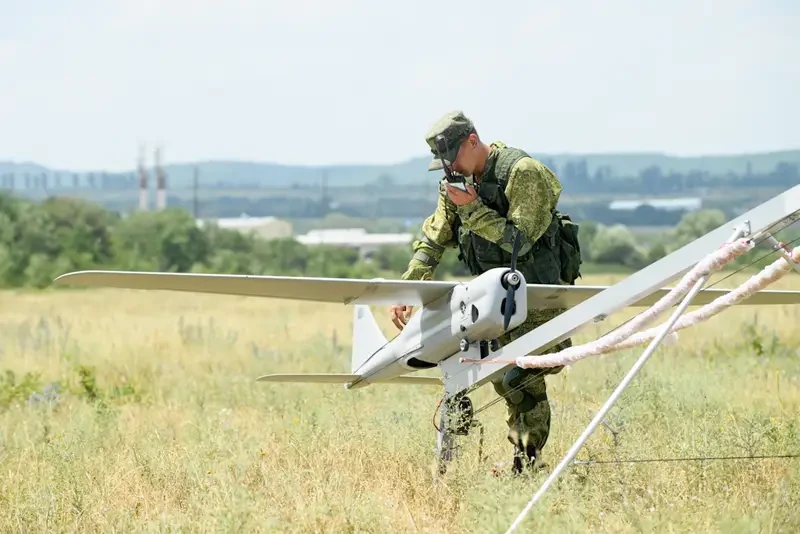
Russian airborne troops use an Orlan-10 drone during an exercise in June 2018. Andrey Rusov/Russian Defense Ministry via Mil.ru
An advanced medium-range drone, the Orlan-10 can perform several different missions, including electronic warfare, target interception, and reconnaissance, surveillance and reconnaissance, known as ISR.
The Orlan-10 has a modular design that allows the operator to switch sensors on and off depending on the mission. Its body is just over 1.8 meters (6 ft) long and has a wingspan of almost 3 meters (10 ft). Its maximum take-off weight is about 2.7 kg. Its operators use a collapsible catapult to launch it and a parachute landing system to retrieve it.
Orlan can carry daylight, thermal and video cameras that provide real-time intelligence to ground units via a data link that uses a 3G/4G cellular network that may be vulnerable to interception or interference by an adversary.
The Orlan-10 also carries a radio transmitter mounted on a gyropod allowing for 360 degree movement. The transmitter allows the Orlan-10 to conduct electronic warfare by distinguishing between friendly and enemy transmissions and jamming the latter.
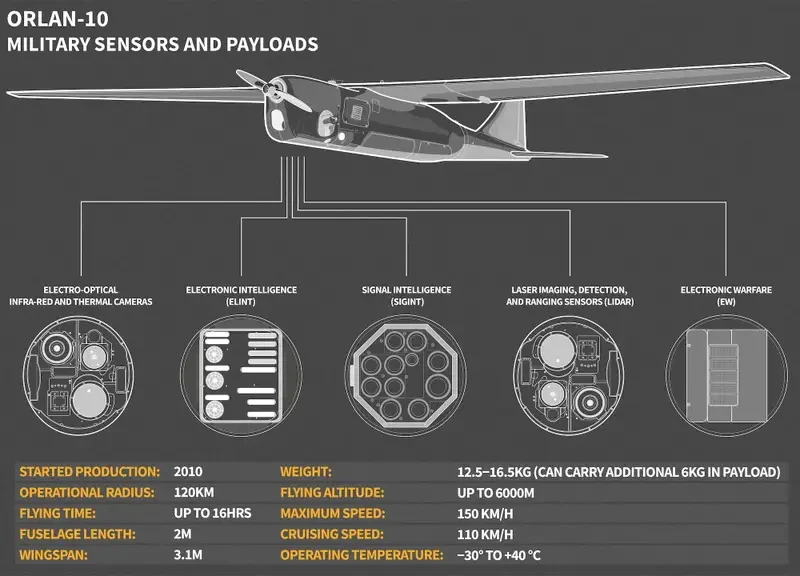
The Orlan-10's specifications and characteristics in a graphic published by the Royal United Services Institute in December 2022. RUSI/Handout via REUTERS
It can work both independently on predefined networks and by remote control. It can transmit its data back to its controllers from up to 600 km (373 mi) away from its command and control station. It can also stay on station for around 18 hours and maintain speeds of 113 km/h (70 mph).
Each Orlan-10 costs between $87,000 and $120,000, according to the Worldwide Equipment Guide compiled by the US military.
Russian forces have used the Orlan-10 drone mainly for reconnaissance and target acquisition. Russian artillery can rain down accurate fire within three minutes of an Orlan-10 being overhead a Ukrainian position, which takes about 20 minutes when Russian drones aren't on scene, according to a Royal United Services Institute report on the Orlan.
Artillery remains Ukraine's deadliest weapon, and both sides use drones to pick up targets and adjust their fire. In a recent statement, British military intelligence said the majority of Russian casualties were inflicted by Ukrainian artillery.
"Made" in Russia
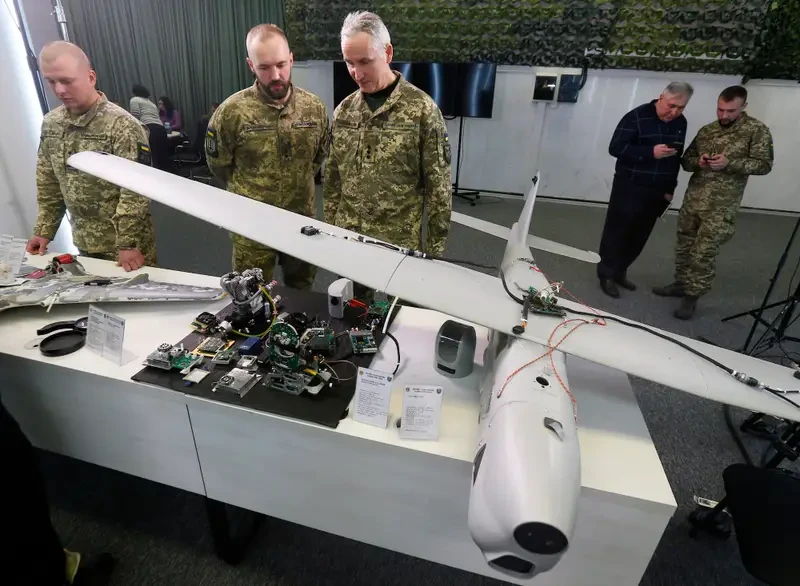
Ukrainian officials display an Orlan-10 and other drones used by Russia on December 15.
STR/NurPhoto via Getty Images
The Royal United Studies Institute's in-depth report on the Orlan-10, released in December, details how Russia relies on Western-made parts and other foreign components to keep the Orlan in the air.
By inspecting the Orlan-10 during fieldwork in Ukraine and by working with open-source data — including financial records, customs data, court records, Russian company documentation and other information collected by Reuters and iStories — RUSI found that the Russian firm that builds the Orlan-10 continues to use Western technology and parts despite heavy sanctions imposed on Russia in response to its attack on Ukraine, which began on February 24, 2022.
Indeed, the report found that companies closely linked to the Russian firm, Special Technology Center Limited Liability Company have been importing more Western technology since Russia began its invasion.
To acquire the technology, the company relies on distributors based in several countries, including the US, China and South Korea. Russian intelligence services are likely involved in procuring this technology through contacts and front companies around the world.
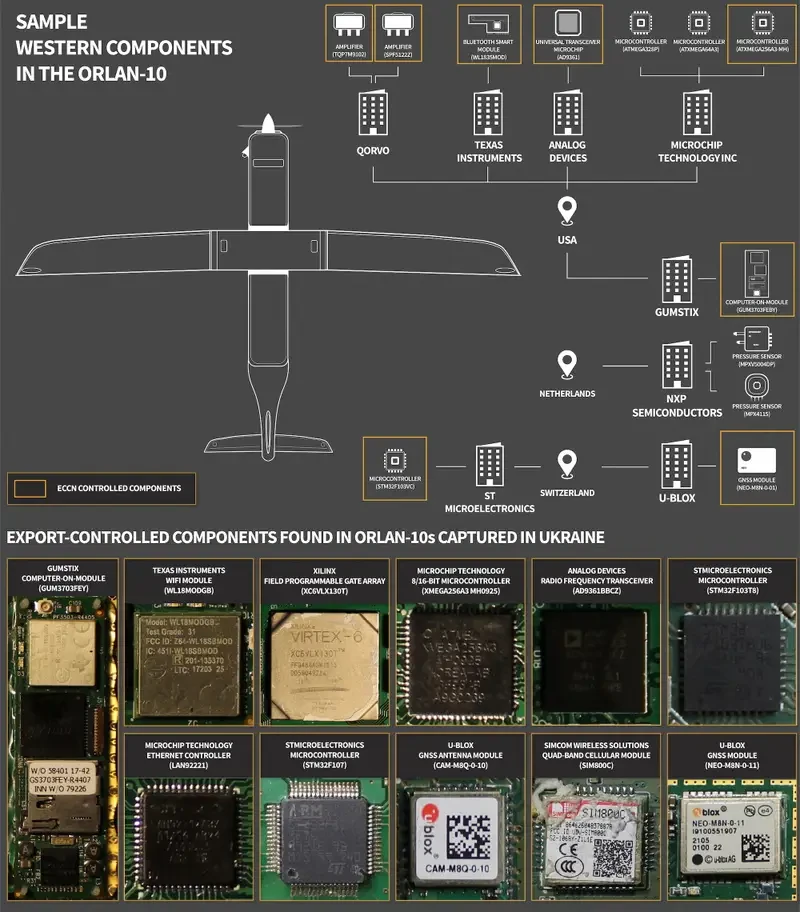
Western-made components found in the Orlan-10, according to the Royal United Services Institute.
RUSI/Handout via REUTERS
In one case, according to the report, a Russian-American citizen was accused of sending large quantities of restricted technology needed for the Orlan-10 operation to Russia.
The report said Orlan-10's "subsystems" are "heavily dependent on foreign microelectronics," particularly the microcontrollers, global navigation satellite system receivers and pressure sensors that allow it to "collect and transmit relevant data" to an operator which can be more than 96 km (60 mi).
The RUSI report estimated that imports would likely allow the Russian military to "maintain and expand production of the country's most successful" drone, describing the Orlan-10 as "a platform that underpins the country's military capabilities" and allows Russia military "to rain accurate fire on the Ukrainian formations".
"Networks like those profiled in this report are at the heart of Russia's ability to deliver advanced microelectronics for its weapons programs," the report said.
28 February, 2023